This website is not completed and we plan to add more videos. We uploaded a VERY ROUGH draft so that early reviewers can get a reference to our method. Thank you for spending your time to review our paper. We plan to complete the website by the end of March.
SCROLLA novel method utilizing Canny edge images as control input to condition video generative models, producing high-quality and diverse robot videos.
A new pipeline for bimanual cross-embodiment manipulation that performs six types of image augmentations in a single framework.
Simulation and real-world experiments demonstrating that policies trained on CRAFT-generated data significantly outperform baselines.
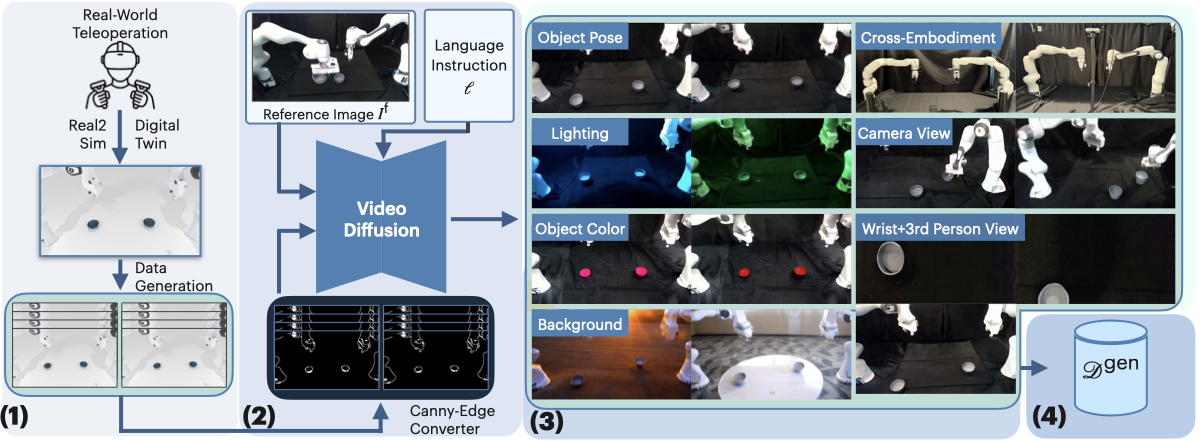
Figure 2: CRAFT pipeline. (1) Trajectory Expansion via Real2Sim digital twin. (2) Video Generation with Canny-edge conditioning. (3) Augmented Dataset Construction across six axes. (4) Generated Dataset for policy training.
Retain too much low-level detail, causing the diffusion model to struggle with salient structural features such as gripper-object contact.
Discard irrelevant details while preserving robot arm and object structure, giving clear guidance and allowing free variation of backgrounds, object colors, and lighting through prompting.
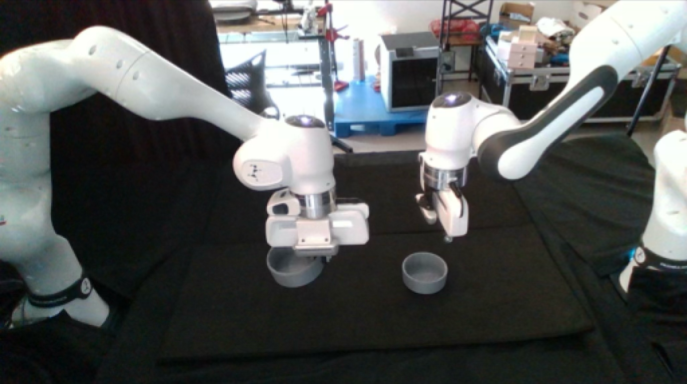
The video above was produced by the video generation model using the language instruction below (together with Canny-edge control).
Overhead shot with balanced, even lighting. Neutral background with clear
illumination across the task area. COMPLETELY STATIONARY background curtains and table - absolutely
no movement, no swaying, no wind, frozen and still like a photograph throughout the entire
video. The background fabric and table fabric remains perfectly static while only the robot arms move.
Two white industrial robotic arms with visible structural detail are positioned symmetrically.
Two light-colored shallow gray bowls are clearly visible on the dark fabric
surface with defined edges.
CRITICAL: The robotic grippers make firm, realistic contact with the bowl edges. Fingers
wrap securely around the bowl rims with no gaps or floating. Natural grasping mechanics
with proper finger placement and stable grip throughout the entire motion. Physical contact
remains consistent with no slipping or separation between gripper and bowl surfaces.
The scene has well-balanced lighting that clearly shows all objects - robot arms, bowls,
and surface - with good detail and natural contrast. No harsh shadows or overexposed areas.
Clean, professional appearance with sufficient light to see all action clearly. Sharp focus
on the manipulation task.
ONLY the robot arms and bowls move - all background elements including curtains, fabric,
and surfaces remain completely frozen and motionless throughout the entire sequence.
4K quality.
Generate photorealistic, action-consistent robot videos from simulator rollouts using a pre-trained diffusion model.
Train ACT on real + generated demonstrations and evaluate robustness under controlled distribution shifts.
Coordinated bimanual task where both arms simultaneously grasp and lift.
Parallel task where both arms independently pick up cans and place them into a container.
Sequential task where two bowls must be stacked on top of each other in order.
Success rates (%). Each method evaluated under test conditions varying only along that dimension. CRAFT (Ours) uses 1000 generated demos + real-world collected demos. Cross-Embodiment: xArm7 → Franka Panda transfer.
Policy rollouts on physical hardware for each augmentation type. Policies are trained with CRAFT-generated data and evaluated under the corresponding test condition.
Currently showing teaser as placeholder. Add your real-world rollout videos to static/videos/rollouts/<augmentation_type>/ and update the source paths above.
For each trajectory, the simulator applies random translations and rotations to the target object's pose, sampled from a uniform distribution over the physically feasible workspace.
We generate diverse lighting conditions by prompting Veo3 to synthesize variants of the reference image under different ambient illumination (e.g., blue or green lighting). Unlike simple color jitter, this preserves scene properties like shadows and surface reflections.
To generate diverse object colors, the model conditions on a reference image of the empty table scene, allowing the language instruction to freely specify the desired color while Canny-edge control provides object contours and location.
To generate diverse backgrounds, we omit the reference image from the video diffusion model—conditioning on it would anchor the generated scene to the original environment. Instead, we modify the language instruction to describe the desired background.
We enable cross-embodiment transfer by retargeting source-robot demonstrations to a target robot using forward and inverse kinematics, mapping end-effector poses to new joint configurations while preserving gripper actions. In our setup the source robot is the xArm7 and the target is the Franka Panda; we generate photorealistic videos for the target robot only, so xArm7 source demonstrations are not shown here. We plan to add videos of the real-world xArm7 demonstrations in a future update.
We tile the left wrist camera, right wrist camera, and third-person (external) camera into a single image. Tiling ensures spatial consistency across all viewpoints—enabling multi-view policy training without collecting real wrist-camera data.
Additional stress tests of our video generation: generation beyond the Franka platform, with object distractors, and with different reference images. Click a tab to view each category.
Examples of video generation beyond the default Franka setup: different robot arms (e.g. single-arm xArm7), backgrounds, and object appearances, alongside the original generation for comparison.
Single arm xArm7 with ocean background.
Pink generation object.
Original generation.
Bimanual robot learning from demonstrations is fundamentally limited by the cost and narrow visual diversity of real-world data, which constrains policy robustness across viewpoints, object configurations, and embodiments. We present Canny-guided Robot Data Generation using Video Diffusion Transformers (CRAFT), a video diffusion-based framework for scalable bimanual demonstration generation that synthesizes temporally coherent manipulation videos while producing action labels. By conditioning video diffusion on edge-based structural cues extracted from simulator-generated trajectories, CRAFT produces physically plausible trajectory variations and supports a unified augmentation pipeline spanning object pose changes, lighting and background variations, cross-embodiment transfer, and multi-view synthesis. We leverage a pre-trained video diffusion model to convert simulated videos, along with action labels from the simulation trajectories, into action-consistent demonstrations. Starting from only a few real-world demonstrations, CRAFT generates a large, visually diverse set of photorealistic training data, bypassing the need to replay demonstrations on the real robot (Sim2Real). Across simulated and real-world bimanual tasks, CRAFT improves success rates over existing augmentation strategies and straightforward data scaling, demonstrating that diffusion-based video generation can substantially expand demonstration diversity and improve generalization for coordinated dual-arm manipulation.
This website is not completed and we plan to add more videos. We uploaded a VERY ROUGH draft so that early reviewers can get a reference to our method. Thank you for spending your time to review our paper. We plan to complete the website by the end of March.